

If there is a tub of magnetic tiles somewhere between your couch and your kitchen, you may have paused at a recent headline. In June 2026, Australia’s consumer watchdog ordered some of the country’s biggest online marketplaces to pull magnet toys from sale. For a lot of parents, the obvious next question was a personal one: are magnetic tiles safe, and is the set my kids play with every afternoon one of the good ones?
The short answer to are magnetic tiles safe is reassuring. The crackdown is aimed at loose, small, high-powered magnets that have been banned in Australia for over a decade, not at properly made magnetic building tiles. The difference comes down to how the toy is built. Here is what the regulator actually did, what Australian toy safety standards require, and a simple checklist for your next toy shop.
Why parents are asking are magnetic tiles safe in 2026
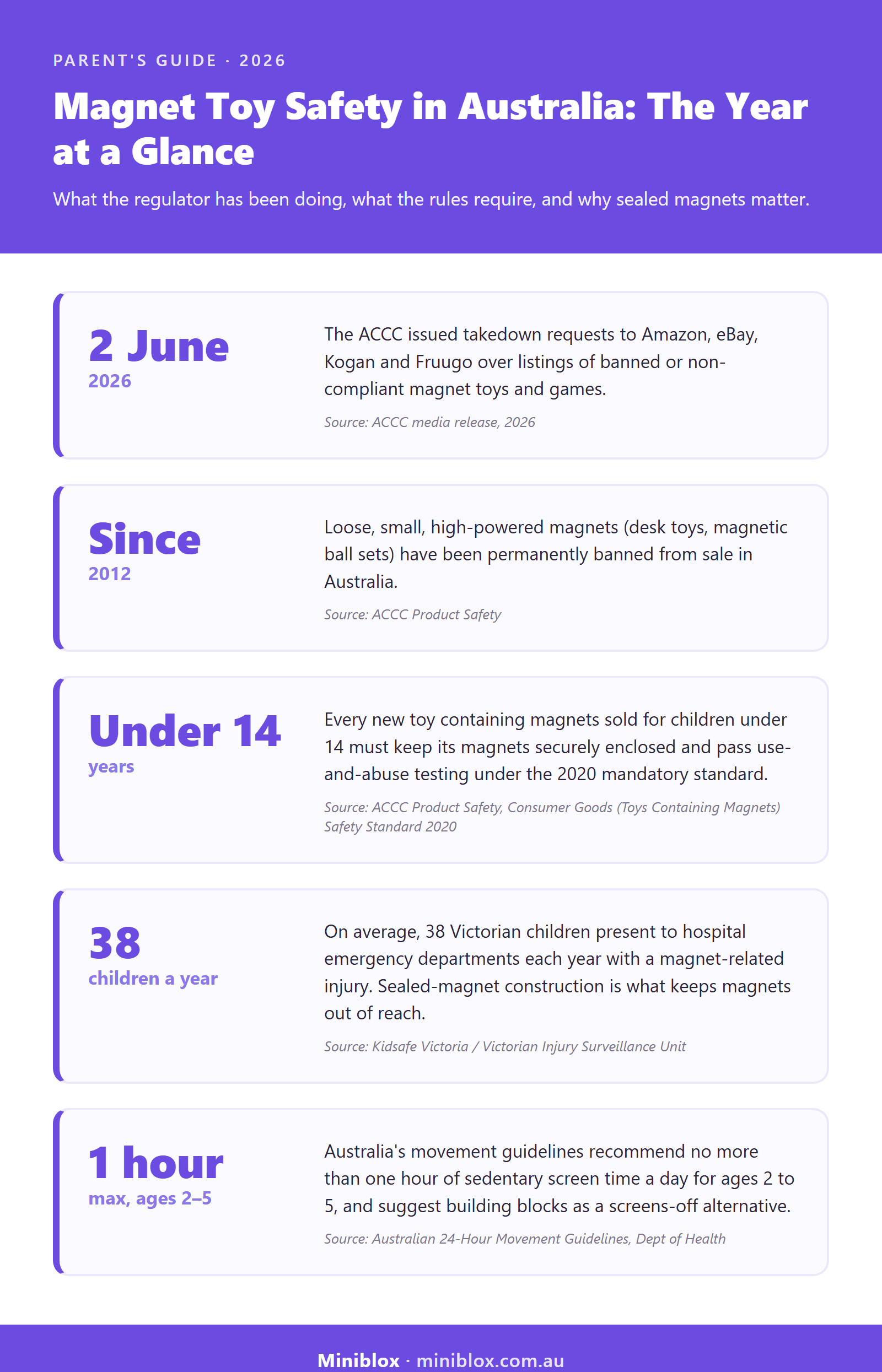
On 2 June 2026, the Australian Competition and Consumer Commission (ACCC) issued takedown requests to Amazon, eBay, Kogan and Fruugo for listings of toys and games containing small high-powered magnets that were either banned outright or did not comply with the mandatory safety standard (ACCC, 2026).
ACCC Deputy Chair Catriona Lowe put the risk plainly: small high-powered magnets can cause catastrophic, life-threatening internal injuries if swallowed, particularly for young children, because multiple magnets can stick together through intestinal tissue. They are also a choking risk. Her advice to anyone who bought one of the affected products was to stop using it immediately, keep it away from children and contact the seller for a refund.
The regulator is not stopping there. Through July 2026 the ACCC ran a limited review of the toys containing magnets mandatory standard, looking at updating it to reference the latest versions of the Australian, international, European and US voluntary standards (ACCC consultation hub, 2026). In other words, the rules protecting kids from dangerous magnets are being actively tightened and enforced right now.
What Australian toy safety standards actually require
Australia takes a two-layer approach to magnets in toys, and knowing both layers makes the news much easier to read.
The 2012 ban on loose high-powered magnets
Loose, small, high-powered magnets, the type sold as desk toys, magnetic ball sets and novelty items, have been permanently banned in Australia since 2012. These are the products the ACCC’s takedown action targeted. They are small enough to swallow and strong enough to clamp together inside the body, which is exactly the combination that causes serious harm (ACCC Product Safety).
The mandatory standard for toys containing magnets
Separate from the ban, the Consumer Goods (Toys Containing Magnets) Safety Standard 2020 applies to every new toy sold for children under 14 that contains a magnet or magnetic component. Magnetic building tiles and blocks sit squarely inside this standard. It requires that small magnets be securely enclosed and inaccessible to a child, and that the toy pass use-and-abuse testing designed to simulate real play: dropping, twisting, biting and pulling. If a magnet can escape the toy under that kind of punishment, the toy cannot legally be sold. The only exception is science experiment kits for children 8 and over, which must carry prominent swallowing-hazard warnings.
This is the part that answers the “are magnetic tiles safe” question. A compliant magnetic tile never lets a child reach the magnet in the first place. The danger the headlines describe belongs to a different category of product entirely.
Why sealed magnets matter so much
The medical picture explains why regulators treat this so seriously. Statistics from the Victorian Injury Surveillance Unit show an average of 38 Victorian children present to hospital emergency departments every year with a magnet-related injury (Kidsafe Victoria). Paediatric surgeon Dr Maurizio Pacilli of Monash Children’s Hospital explains that when a child swallows two or more magnets, they are drawn to each other and can lock together inside the body, which can cause bowel perforation, blockages and infection, and requires urgent surgery.
If you ever suspect a child has swallowed a magnet, seek urgent medical help. Do not wait for symptoms.
That is the risk profile of loose magnets. When parents ask are magnetic tiles safe, they are really asking whether the magnets can ever get out, which makes construction method the single most important thing to look at when buying magnetic building tiles. At Miniblox, every magnet is sealed inside the tile by ultrasonic welding, a process that fuses the plastic shut rather than relying on screws or glue, so the magnets stay where they belong through years of enthusiastic play. The tiles themselves are made from food-grade, non-toxic ABS that is free of BPA, phthalates and latex, and the range is STEM-authenticated and designed for ages 3 and up.
A parent’s checklist before you buy
Whether you are buying from us or anyone else, the same rules of thumb apply to magnetic tiles Australia-wide. Kidsafe Victoria’s guidance for magnetic products, adapted for tiles and blocks:
- Check how the magnets are secured. Sealed or welded construction beats glued or screwed panels. If a listing cannot tell you how the magnets are held in, treat that as your answer.
- Check the material, not just the magnets. Look for non-toxic, BPA-free plastics, since tiles spend plenty of time in small hands and occasionally near small mouths.
- Supervise and inspect. Even a well-made toy has a hard life. Keep an eye on play with any magnetic toy, and give the set a quick once-over now and then.
Are magnetic tiles safe? Your questions answered
Are magnetic tiles safe for toddlers?
The magnetic tiles age range on quality sets is 3 and up, and it is worth respecting, because younger siblings are the ones most likely to mouth a broken piece. If you are wondering are magnetic tiles safe for a one year old, the honest answer is not yet. For babies and toddlers, choose an age-appropriate option instead, like soft, chewable Jelly Blocks, which contain no magnets at all.
Are magnetic tiles safe once a piece is damaged?
No. A cracked tile is the one situation where a sealed magnet could eventually work loose, so retire the damaged piece immediately. The rest of the set is fine to keep using.
Are magnetic tiles safe to buy online?
Yes, provided the seller answers to Australian rules. The ACCC’s takedown action shows that overseas marketplace listings are where banned and non-compliant products slip through, so an Australian retailer with a real local presence is the lower-risk choice.
The other reason parents are choosing magnetic building tiles
It is worth remembering why this category exists at all. The Australian 24-Hour Movement Guidelines recommend no sedentary screen time for children under 2, and no more than one hour a day for ages 2 to 5, with less being better (Australian Government Department of Health). The same guidelines suggest filling quiet time with puzzles and building blocks, which is about as direct an endorsement of open ended play as a government document gets.
Magnetic tiles have become the go-to screens-off option in Australian homes, classrooms and therapy rooms because one set does so many jobs. There is no single correct way to use them, so the same box builds a rocket on Monday and a marble run on Friday. That is open ended play in practice: the child sets the goal, and the toy keeps up. It is why our sets are loved by over 10,000 Aussies, backed by 2,472 customer ratings.
Are magnetic tiles safe? The bottom line
Made properly and sold under Australian toy safety standards, yes. The 2026 crackdown is good news for parents: it targets the banned, loose-magnet products that cause the injuries, and it holds online marketplaces to account for hosting them. Your job at the checkout is simply to buy tiles with sealed magnets from a seller who complies with the mandatory standard, and to retire any piece that gets damaged.
If you are ready to build, explore our full range of magnetic tiles and magnetic blocks, all made in Australia’s compliance lane: ultrasonically welded magnets, food-grade ABS and STEM-authenticated designs for ages 3 and up. Questions about which set suits your child’s age or a sensory need? We are always happy to help you choose.
Get our play ideas first on Google
Add Miniblox as a preferred source and our newest activity guides will pop up first in your Google results.