

Before you hand any new toy to a toddler, it is fair to turn it over and ask a simple question: what is this actually made of? With something as squishy and squeezable as Jelly Blocks, that question matters even more, because little kids will stretch them, stack them and, let’s be honest, probably taste them. So here is the straight answer to what are Jelly Blocks made of, and why the material is a big part of what makes them a family favourite.
What are Jelly Blocks made of? The short answer
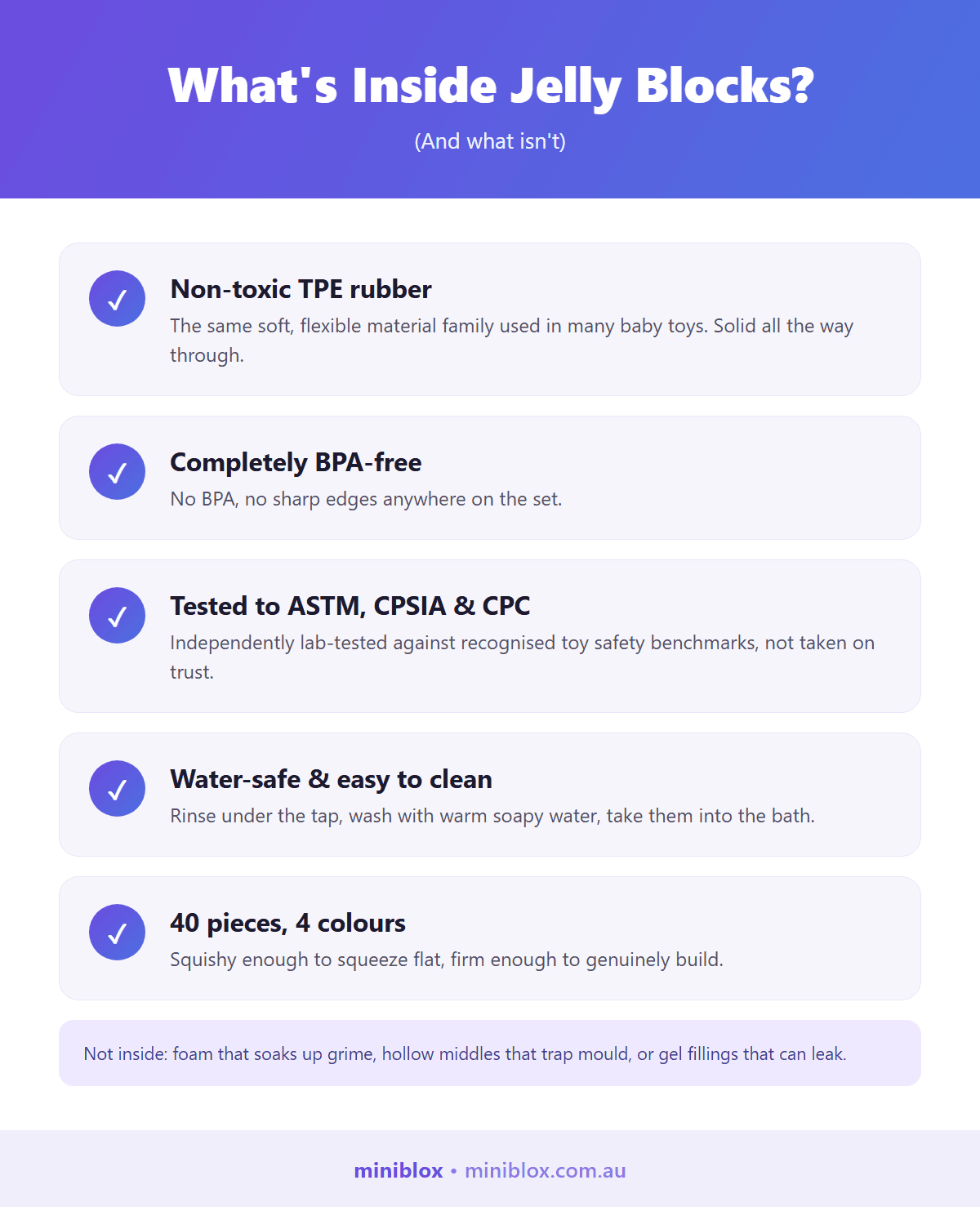
Jelly Blocks are made from thick, non-toxic TPE rubber. TPE stands for thermoplastic elastomer, a soft, flexible, rubber-like material that is a staple of baby toys and teethers precisely because it is gentle, durable and easy to keep clean. It is what gives the blocks their signature squish: firm enough to stack and build with, soft enough to squeeze flat and watch spring slowly back. Every set is completely BPA-free, with no sharp edges anywhere on the 40 pieces.
Tested, not just soft
Being soft is not enough on its own, so Jelly Blocks are tested to meet ASTM, CPSIA and CPC safety requirements. In plain English: ASTM F963 is the recognised toy safety standard covering things like materials, small parts and durability; CPSIA is the law that requires children’s products to be tested by an independent accredited laboratory; and a CPC is the children’s product certificate issued on the back of that testing. Together they mean the material, the design and the finished blocks have all been checked against recognised toy-safety benchmarks rather than taken on trust. It is the same style of certification parents should look for on any children’s toy, squishy or not.
Easy to keep clean, even after the sandpit
Because each piece is solid TPE rubber all the way through, Jelly Blocks are water-safe. There is no foam core to soak anything up and no hollow middle to trap gunk, so you can rinse them under the tap, wash them with warm water and mild soap, and even take them into the bath, where they happily double as bath toys. For anything that lives in a toddler’s hands, “easy to sanitise” is a genuinely underrated feature.
Soft does not mean flimsy
A fair question parents ask about squishy blocks is whether they actually build. They do: the pieces press together and hold, and an educator in our reviews put it nicely, saying that unlike other squishy toys, “they actually stay together for you to build with.” The honest trade-off of a flexible material is that wobbly skyscrapers are not the goal here. Jelly Blocks are at their best building chunky figures, animals and small towers, and being mashed flat and rebuilt a hundred times. That flexibility is also exactly what makes them one of the most satisfying sensory blocks you can hand an overwhelmed little one at the end of a big day. One more practical note: they are their own system, so they will not clip onto hard plastic building bricks, but they stack beautifully with each other.
How the material compares with other squishy toys
Not all squish is created equal, and the material choice is where the differences hide. Foam-based squeeze toys are light and cheap, but foam soaks up water and grime, tears at the corners, and cannot be properly washed once liquid gets in. Hollow rubber toys (the classic bath squirter problem) trap water inside, where mould happily sets up home. Gel- and bead-filled toys feel wonderful right up until the skin splits and the filling is suddenly on the loose. Solid TPE sidesteps all of it: nothing to absorb, nothing to leak, nothing hiding inside, and the whole block can go under the tap. For a toy that will be squeezed hundreds of times a week by hands of unknown cleanliness, solid-all-the-way-through is the feature that keeps on giving.
A few care questions parents ask
Is it okay if my toddler chews one?
Will they perish or go sticky over time?
Can they go in the dishwasher?
Why the material matters
Put it all together and the material choice is the whole story. Soft, non-toxic, BPA-free, water-safe and independently tested is exactly the combination parents, teachers and occupational therapists look for in soft building blocks for young kids, and it is why Jelly Blocks pull double duty as both a construction toy and a calming fidget. The 40-piece set comes in four colours, holds a 4.78-star average across more than 220 reviews, and like everything at Miniblox is backed by a 30-day money-back guarantee.
If that sounds like what your family needs, take a closer look at Jelly Blocks, see our favourite ways to use them in sensory play ideas with Jelly Blocks, or pair a set with our magnetic tiles for the full build-and-squish toy shelf.
Get our play ideas first on Google
Add Miniblox as a preferred source and our newest activity guides will pop up first in your Google results.